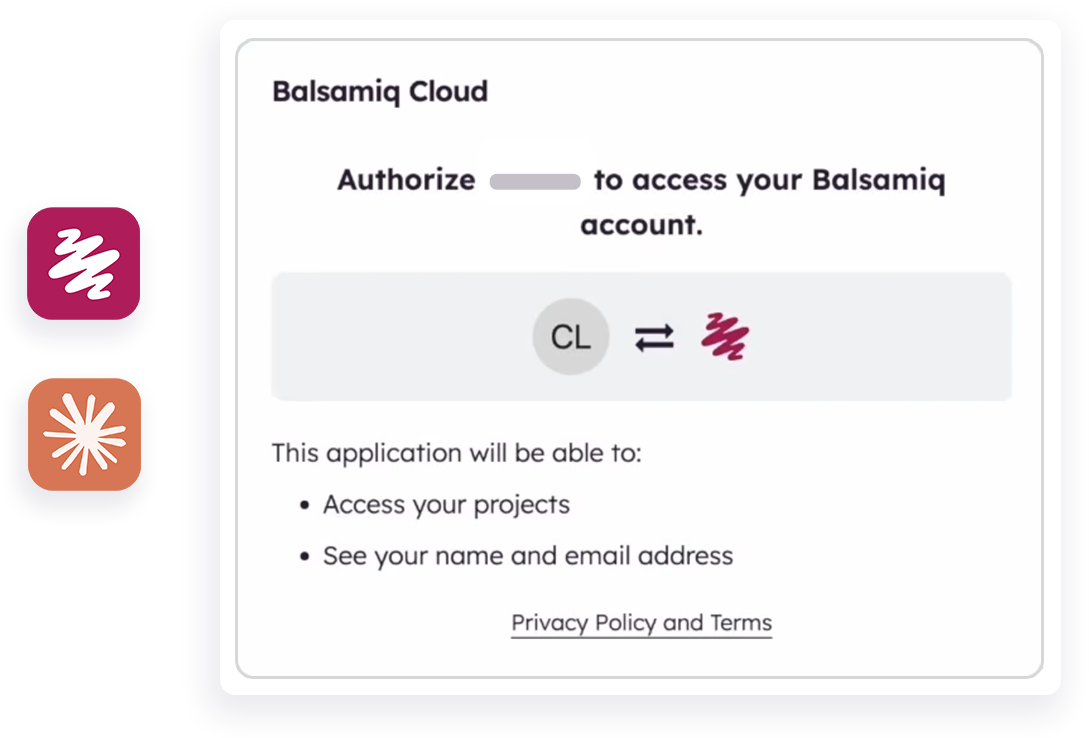





You're already using Claude. Good.
The question isn't whether to use Claude… it's whether what you're handing it is worth building. Claude Design jumps to pixels. Claude Code jumps to working features. Neither tells you if you're solving the right problem.
- Claude Design, Claude Code, Claude Cowork, Claude Chat: each one a different stage of building.
- None of them ask if you're solving the right problem first.
- Balsamiq integrates with Claude. It's not a replacement, it's the step before.
The rebuild is where fast gets expensive.
Every team that rebuilt in Claude moved fast at the start. The problem wasn't speed, it was skipping the step where bad ideas get caught before they become bad products.
- Catching the wrong idea in Balsamiq costs almost nothing. Catching it after Claude built it costs a lot.
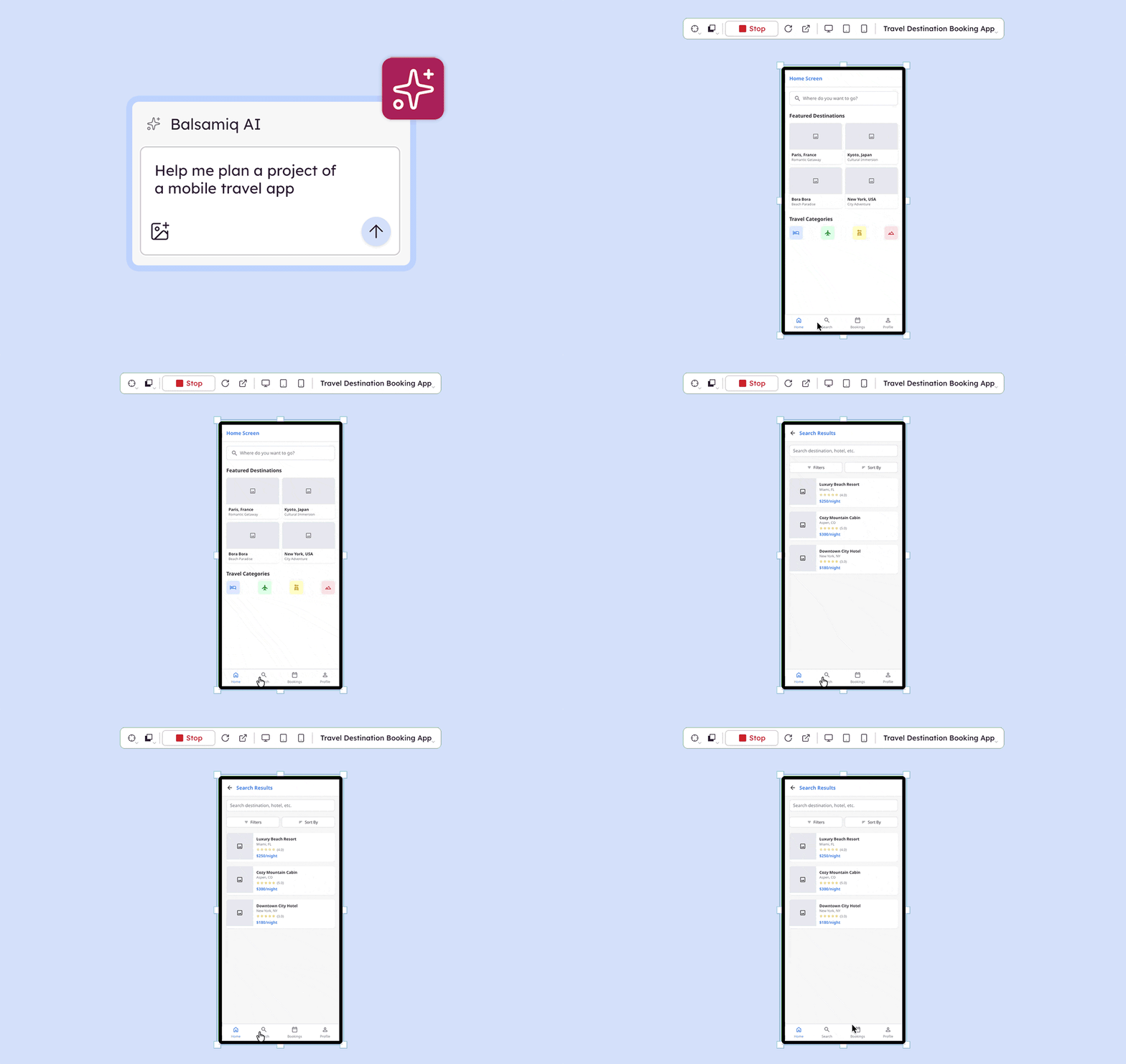
- Balsamiq AI generates wireframes from a prompt, screenshot, or sketch — so you're not slowing down, you're starting in the right place.
- Share with stakeholders, test with users, and iterate without leaving Balsamiq.
Your prototype becomes the prompt.
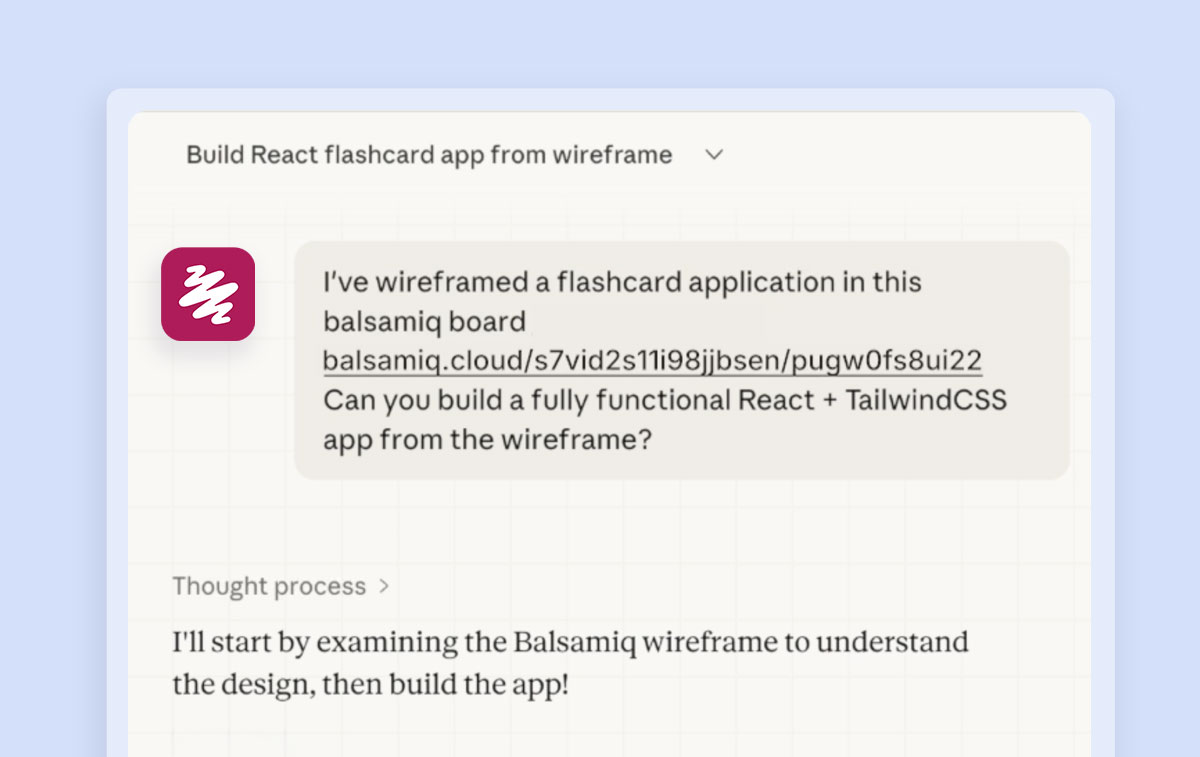
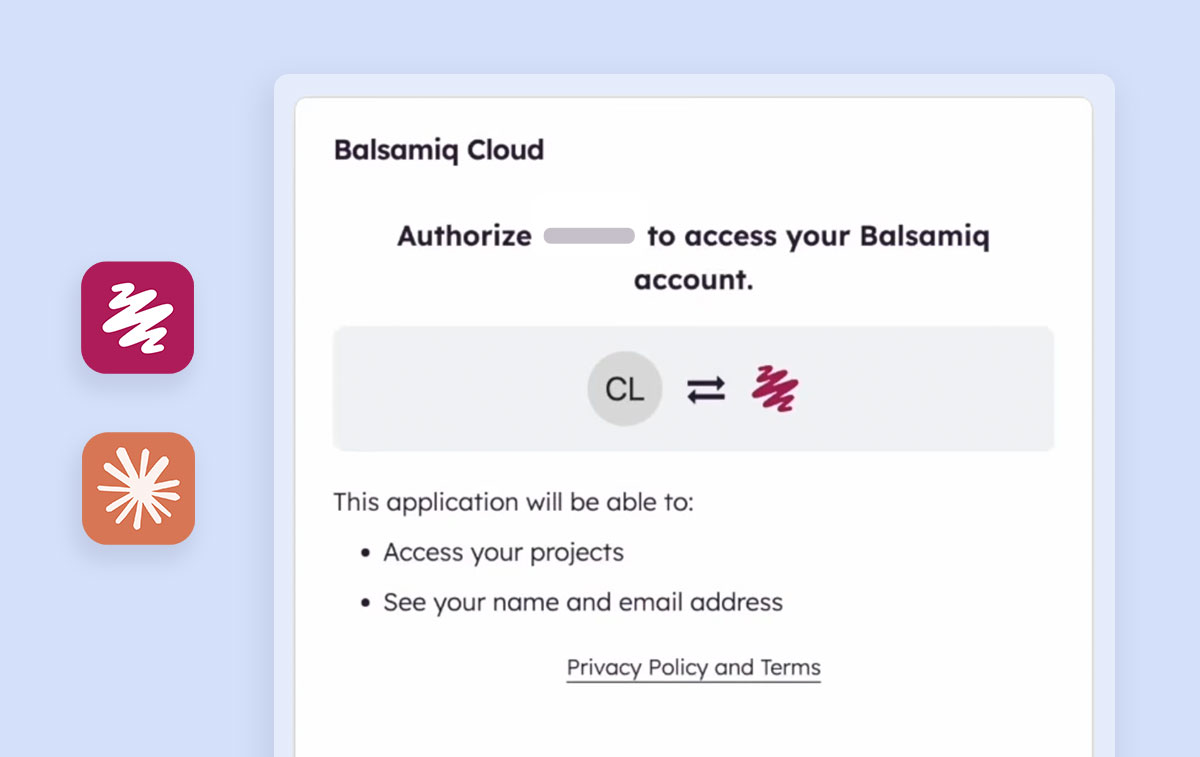
Once you've validated what to build, Balsamiq hands it off. Connect to Claude via the MCP server so it can read your prototype and get to work with structure, flow, and logic already figured out.
- Hand off validated designs to Claude, Cursor, or your AI coding tool of choice.
- No more describing your idea to an AI. Show it.
- PMs, founders, engineers, and consultants use it every day. No design background required.
Let's compare Balsamiq vs. Claude
| Feature | Balsamiq | Claude Design | Claude Code |
|---|---|---|---|
| Best for | Product thinking, validation prototyping, & handoff | High-fidelity UI design from a prompt | Building production-ready code from specs |
| AI wireframing | Prompt, screenshot, or sketch | Yes, but jumps straight to high-fidelity | Nope |
| AI prototyping | One click from wireframes | Yes, but no structured thinking layer | Builds final product |
| Output fidelity | Lo-fi wireframes & mid-fi interactive prototypes | Hi-fi, cookie-cutter designs | Hi-fi production-ready, working software |
| Cost to change direction | Low — move a component, update a flow, done | Medium — structural changes mean token spend and starting over | High — rebuilding a feature costs compute time, token spend, and engineering review |
| Pricing | $16/mo per editor (billed annually), reviewers free Try it free for 14 days |
Included with Claude Pro ($20/mo per seat) — plus token costs per iteration | Included with Claude Pro ($20/mo per seat) — plus token costs per iteration |
| Enterprise | $35/mo per editor (billed annually), up to 400 projects, SSO | Custom pricing for larger teams | Custom pricing for larger teams |
| Collaboration | Unlimited reviewers, every plan | Basic sharing; not fully multiplayer | Per seat |
| Learning curve | Extremely low, anyone can contribute | Low | High — requires technical knowledge |
See how Balsamiq works
Product teams love Balsamiq!
-
Still love Balsamiq for initial, lo-fi user interface designs. Any other app with more bells & whistles would distract me. Happy user since Oct 2008 (yes, just looked it up).
 Erik van EykelenFounder
 -
The customer support team at Balsamiq is one of the most helpful I've ever encountered.
 Nakul VermaCo-founder
 -
When prototyping a web or mobile application with Balsamiq, my productivity skyrockets. More focus on the core business idea and less focus on margins, colors, fonts, etc.
 Njogu AmosFull-stack Developer
 -
I worked on some design assignments last weekend and discovered an application called Balsamiq. In just a few hours, I whipped up low-fidelity wireframes that made me look like a design ninja. 🥷
 Anshita DeshmukhProduct Designer
 -
I use Balsamiq to sketch out initial concepts and the team loves my "hand-drawn mockups" :D
 Tosh AnandProduct Designer
 -
Happy to confirm my hunch: Balsamiq is still the best (and better than all the well-funded competitors).
 Brian CaselWeb Designer
 -
Balsamiq rocks! Best money I've ever spent.
 Gareth StephensonSoftware Engineer
 -
One tool I use a lot and have been using for at least 10 years is Balsamiq. There are much more full-featured and prettier wireframing tools available, but for quickly turning an idea into a shareable vision with other people it's been hard to beat.
 Pete SergeantSoftware Engineer
 -
I'd never made a wireframe before but I learned Balsamiq at 10 pm last night and now I'm kind of a groupie.
 Laura McKieranExecutive Director
FAQs
Does Balsamiq have AI features?
Yes. Balsamiq AI generates structured, editable wireframes from a prompt, screenshot, or sketch. One more click turns them into a clickable, shareable prototype. The difference from Claude Design isn't speed — it's where in the process you're being fast. Balsamiq AI is fast at figuring out what to build. Claude Design is fast at making it look finished. Those aren't the same thing.
Can't Claude Design just replace this workflow?
Claude Design jumps straight to pixels. That's the problem. When output looks production-ready, stakeholders approve it before anyone's asked the hard questions — and the wrong thing gets built, fast. Balsamiq is the step before: where the idea gets pressure-tested before anyone's time or sanity are on the line.
I've been mocking up in Claude. What does Balsamiq add?
A thinking layer Claude doesn't have. Balsamiq's purpose-built UI components keep feedback on structure and logic — not colors and typefaces. Stakeholders react to the idea, not the polish. And when you're done, the Balsamiq MCP server hands your validated prototype directly to Claude to build.
Does Balsamiq work with Claude?
Yep! That's the whole point. Connect via the Balsamiq MCP server and Claude can read your wireframes to generate user stories, write code, spot missing states, or review designs against a PRD. Your prototype becomes the prompt.
What kinds of teams use Balsamiq?
Product managers, founders, engineers, and consultants who need to align their team on the right idea before anyone opens a design tool. If your job is deciding what gets built — not just building it — Balsamiq is for you.
Which tool is better for collaboration and feedback?
Balsamiq. Built-in commenting, annotations, and interactive prototypes make it easy to gather specific, actionable feedback async or in real time. Everyone can contribute regardless of their plan, with no seat limits to worry about.